Thanks to Frans de Waard for the kind words!
We were already aware that Ballast NVP releases special projects in
small editions. This time they reach another peak with this one. Dead
Edits, being Eric Lunde and label boss Blake Edwards came up with a
small box with dice with letters on it, nine in total, so you can spell
Dead Edits. There is also a dice shaker and three scorecards. A bit
like Yahtzee or Boggle? I don't know. I never play games, analogue or
digital. I won't explain the details of this game too much, even when
it’s not complicated, but you get more points if you spell certain
words, 78 if you spell Dead Edits, as one word. Having no one around
here to play this game, I can't say if it's great, but I sure love the
wacky idea of this. The cassette that comes with the package contains
one side Edwards rolling the dice and Lunde finding words with those
letters, whereas on the other side Lunde keeps on finding words and
Edwards trying to pronounce the words the dice roll. It sounds like
sound poetry, and it is great. It comes with machine noises in the
background, Great poet cut-up tape loops and, apparently, cat sounds.
Furthermore, it is short as well, sixteen minutes only, so the best
thing one can do is to have this on repeat at a low volume in the
background while playing the game. You got to hurry up, as this is an
edition of sixteen copies only. This is by wide and far the best
package of this week, despite the short review. (FdW)
––– Address: https://ballastnvp.blogspot.com/
Tuesday, May 18, 2021
Dead Edits: Dead Edits Presents Dead Edits, the Dead Edits Dice Game reviewed

Tuesday, April 20, 2021
Recent reviews of shallows, shallows II, elettra
some kinds words from Frans de Waard in the recent issue of Vital Weekly!
"Blake Edwards, the man behind Vertonen, is not someone who does things
by half, as he proves, once again, with three new releases. I am quite
a fan of most of his work, except for some of his noise work. With such
a body of work, you could think that much of it is in the similar
musical territory, but then you are wrong.
The approach Edwards has towards the world of drones has many faces and here he shows how that works out. 'Shallows' and 'Shallows II" (not sure why he didn't use a double CDR release in one package) are work in which he uses field recordings, drones, small objects and creates some very interesting sound collages with this material This time it is not all put together in one big mass of sound, but in a more linear approach. Vertonen explores a few sound events and then moves on. On 'Shallows' there are more or fewer breaks within the piece, whereas on 'Shallows II', they are cross-faded slowly. The cover details the various sections, and they all have track titles (which reminded me of track titles by Hands To), so why he didn't go for cutting these into separate tracks, I don't know. The differences, so I gather from the information, lie in what sounds are used.
On 'Shallows' this is "raw and processed field recordings with a focuses on over air recordings from closed, resonant internal spaces (churches, ventilation systems) external spaces (fields, forests) and external transmissions (shortwave radio)" and on 'Shallows II' "small manipulated objects and machines (cassette and microcassette recorded direct, small wood and metal assemblages), and processed field recordings", but it is not easy to distinguish that with the result found on these discs. On 'Shallows II" there is a whole section that I would think is all ventilation systems. Which, perhaps, only means, what do I know? I very much enjoyed the quiet approach Vertonen has here, bringing a much-needed rest in the headspace here, following some turmoil of a few days.
The linear approach as well as the collage-like style of using different elements to tell his story works wonderfully well. The covers are hand-painted gouaches and will disappear over time, depending on how you handle them. I love that idea.
'Elettra' is a somewhat different work, a bit louder and working with 'raw and processed shortwave signals'. I love the use of shortwave signals a lot. It is, next to the human voice, one very easy instrument to play (although it needs practice and creativity; that goes without saying). I have no idea if Vertonen uses a real radio or uses the one from the University of Twente, which allows you to tap deep into all short, mid and long frequencies worldwide. Also, I don't know what Edwards does with these radio waves in terms of the processing; analogue or digital or perhaps a combination. He does something, that I am sure of. I believe I hear in each of the six sections to hear a mix of various signals and a few additional sound effects. Throughout this album is all a bit louder than the other two, or rather more present in the overall sound approach, but at the same time, it is effectively music of a similar quiet approach and deep listening. This is closer to the more usual drone approach of Vertonen, and it has the usual intense and mysterious sound that I know and love so much from him. There are so many voices on this release, just radio waves in many layers, and coloured by the use of sound effects. Excellent release. It once again made me think that a book on the historical use of radio signals as instruments is something I would welcome a lot, providing people such as Vertonen will get a place in there too!
Thursday, April 15, 2021
Ballast NVP037, dead edits: dead edits presents dead edits, the dead edits dice game (aka deadzee)
When Eric and I were talking at the end of 2020 about ideas for forthcoming dead edits releases, we landed very quickly on “dice game.”
This is the result.
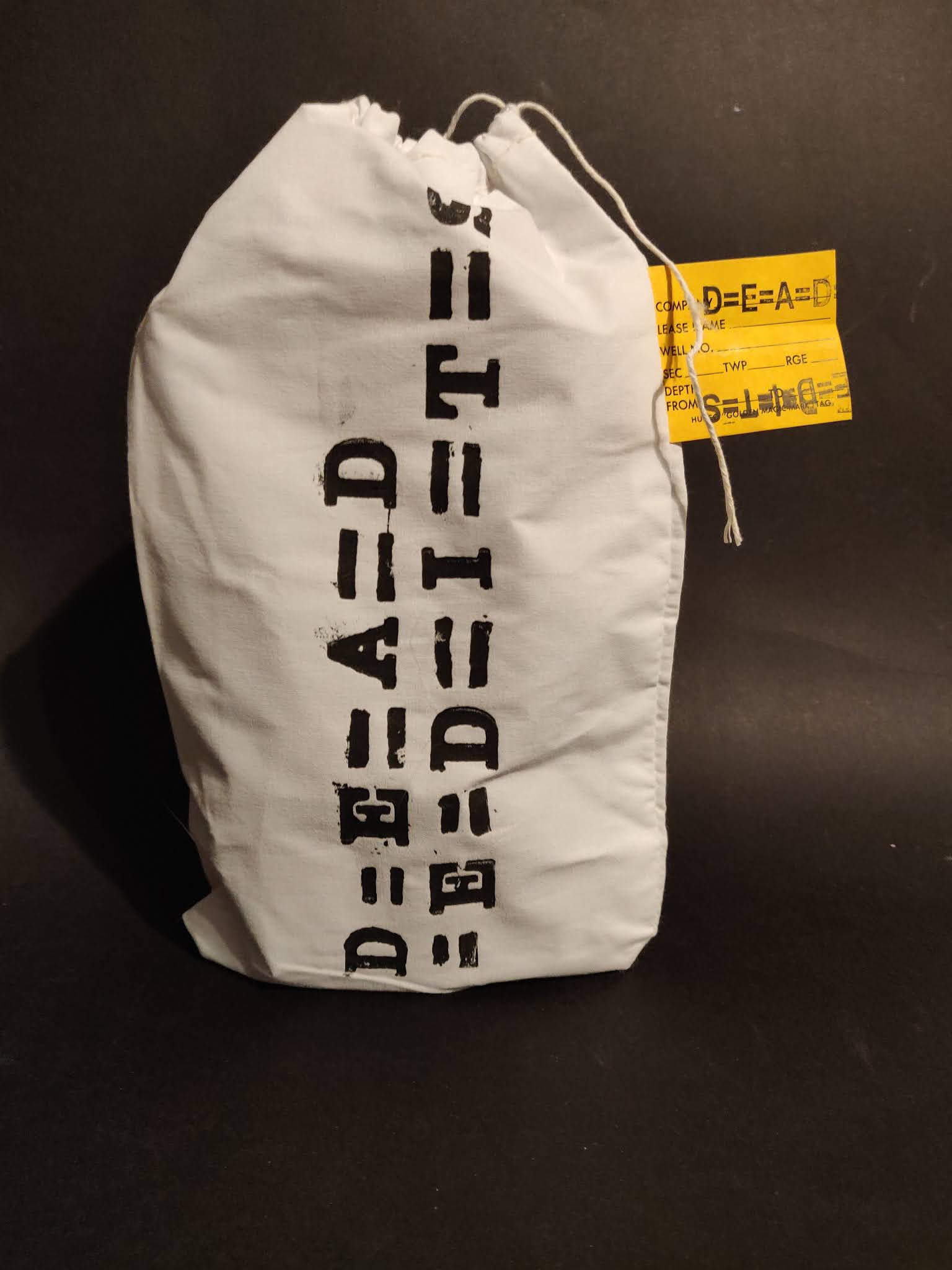

The game is essentially rolling dice to spell words (thanks, Canadians playing on their yachts in the 1930s!), although we suggest variants that encourage neologisms, exquisite corpses, and other ways of playing with language. Consider it an extension of the idea of recordings that encourage audience participation (lock grooves mutli-speed records, etc.).
Five scorecards are included.
The audio (c-16) is split up
as follows:
side 1 is a study of tape warble accompanied by the sounds of Blake rolling
dice and Eric finding words in the dice he rolled. Side 2 is Eric continuing to
find words while Blake pronounces whatever "words" appear with a single roll of the
nine die. Blake’s cat Em Dash makes some guest appearances.
Consider the recording a combination of Trista Tzara’s offer to write a poem by pulling words out of a hat, a field recording, vocabularyclept poetry, and sound poetry.
Edition of 16 signed and numbered copies. $30 ppd in the US—overseas, please get in touch for shipping.
Thursday, March 18, 2021
Ballast NVP 33, 34, and 35 now available
three new vertonen releases now available.

from left to right:
ballast nvp033: vertonen: elettra CDR
Raw and processed shortwave recordings. Plenty of activity in the stereo field, some drones, some voices. Lettered edition of 26 in cardstock sleeve.
ballast nvp034: vertonen: shallows CDR
Raw and processed field recordings with a focuses on over air recordings from closed, resonant internal spaces (churches, ventilation systems) external spaces (fields, forests) and external transmissions (shortwave radio). Plenty of activity in the stereo field, generally quiet listening. Numbered edition of 33 in cardstock sleeve.
ballast nvp035: vertonen: shallows II CDR
shallows II focuses on small manipulated objects and machines (cassette and microcassette recorded direct, small wood and metal assemblages), and processed field recordings. This recording was fueled by a desire to explore some ideas / structures in different settings (and with different aural emphases) thank shallows. Still plenty of activity in the stereo field, though, and still generally quiet listening. some voices. Numbered edition of 33 in cardstock sleeve.
Both shallows and shallows II come with hand painted (gouache) covers that are designed to wear off over time, depending on handling. “Nothing left now but the recordings” indeed.
each disc is $8 ppd in the US (or $20 for all three): overseas, please get in touch for shipping info.
Sunday, November 15, 2020
Ballast NVP032 and 31 out now!


Hali’s work focuses on processed 78 RPM records and cylinder records, shortwave, CB, and field recordings. Her releases and live performances are immersions into odd liminal worlds, where signals and ideas crossfade and collide, distorting originals forms just beyond the brink of familiarity yet retaining enough grounding to recall familiar forms.
“Homer & Langley” is an audio tour (of sorts) of the Collyer brothers’ mansion in New York—often considered one of the first examples of “hoarding” brought to the public’s eye in America. Reflective of the literal impenetrability of the property given all the obsessively collected materials inside, these two short tracks offer intriguing slivers of an aural glimpse inside the mansion.
For a more immersive
“visit,” the first 20 copies come with a bonus flash drive containing the
following:
1) a 15 minute narrative (with accompanying soundtrack) by Hali about the
Collyer brothers (in both .wav and .mp3 format)
2) select contemporaneous newspaper articles
3) select contemporaneous photographs
The 15 minute narrative comes in both .wav and .mp3 formats.
These first 20 copies come in a hand-stamped cloth bag with an envelope filled with early 20th century ephemera assembled by Hali.
Edition of 52 copies. $10 ppd US; overseas, get in touch for shipping.


Edition of 22 signed and numbered copies.
Thursday, November 5, 2020
Three New Vertonen Releases!


I’m not particularly interested in religion, but there are some personas, Joan of Arc being one of them, that I will contend eclipse any belief system. I had finally sat down to read through her trial and, while I knew some of the key turns in it, I was amazed by her sheer force of will and fortitude in what was a completely loaded trial.
The audio is drawn from a processed, computer-generated woman’s voice reading, in French, what is arguably her most famous utterance during the trial. Asked if she knew whether she was in God's grace, she answered: "If I am not, may God put me there; and if I am, may God so keep me.” Of course, the question was a trap: she could not answer yes (because according to doctrine, no one could “know” they were in God’s grace) and she could not answer no, for then she would admit to being in a state of sin. Her deft response “left the court stupefied.”
The audio is fairly dronish / minimal, and I am extremely satisfied with it. This has become one of the few releases of my own that I’ve listened to repeatedly after editing.
Edition of 26 signed and lettered copies in an envelope with a stamp of Joan of Arc’s signature and a insert that includes (in 21st century, re-translated French) all the quotes directly attributed to her during the course of her trial.
$13 ppd in the US; for folks overseas, please contact me so I can calculate shipping.
NVP029, Vertonen: Disorientation Studies (book and 4 x 3” CDR), focuses on geographic surveys. The text explores the history of cartographic studies in three ways: definitions (from the Bureau of Land Management), an overview of key historic moments in surveying, and the surveying “notebook” of a rather uncertain (and perhaps slightly unhinged) surveyor: consider Donald Crowhurst’s ship log as a starting conceit. The artwork in the book reflects this “surveyor’s” mapping as it evolves over the course of the process.
The audio on the four discs reflects the contents of the book: two unprocessed field recordings, one slightly processed field recording, and one heavily processed field recording. Edition of 33 signed and numbered copies.
$20 ppd in the US; for folks overseas, please contact me so I can calculate shipping.
NVP030, Vertonen: Disassociation Studies (book and 4 x 3” CDR), focuses on erasing. The book, besides some introductory framing texts, is focused on erasing and asemic writing: prepared / processed texts treated as graphics / visuals. Samples are included in this email. The audio primarily explores aspects (and shortcomings) of analog erasing as well as the idea of processing audio (either by analog or digital means) well beyond their starting point. (Note: there are no blank discs: there is audio!) Edition of 33 signed and numbered copies.
$20 ppd in the US; for folks overseas, please contact me so I can calculate shipping.
Sunday, October 4, 2020
Luer "Dog Days" 2 x 3" CDR and Vertonen "Drowning Machines" 2 X CDR
Thanks to Frans De Waard for his kind reviews of Luer’s Dog Days 2 x 3” and my own Drowning Machines 2 X CDR…both of which I realized I didn’t get around to even annoucing here, so here we go for a double whammy.
Ballast NVP028: luer: dog days (2 x 3” CDR)
Over the past few years, Matt Taggart has been doing a lot more work with modular synthesizer gear, and the results here are some of my favorite, for a few reasons. First, the stereo field is in full play. This isn’t to say his previous recordings (either as Luer or PCRV) haven’t explored the stereo field, but the slow burn of the tones combining and evolving stereophonically, is for me some of his strongest. Second, and tied to Matt’s exploration of the stereo field, both of these discs, which are drone-based, are testaments to Matt’s compositional ability to let one or two slowly evolving tones linger and fill a space. One of the reasons I appreciate this so much comes from knowing Matt’s previous work as PCRV, which was more of a harsh noise style that jumped around quite a bit, as well as his live sets, which also had a lot of quick edits. I’m intrigued as to how friends change and shift as artists, and Matt’s compositional decisions here, their restraint, is wonderful.
The release also comes with a cut up collage Matt created, which listeners are encouraged to reassemble however strikes their fancy.
Edition of 30 signed and numbered copies. The price in the US is $12 ppd. If you're overseas, please get in touch so I can calculate shipping. Payment can be sent via paypal to endtime34@hotmail.com.


Review:
As Luer, Taggart
seems to enjoy the wilder end of drone music on the second disc and the first
one options for a more broken-up sound, but that too is quite forceful at
times. Not necessarily 'loud', I would think, but 'heavy' in approach. The
addition of reverb on both pieces helps quite a bit in the department of 'heavy
atmospherics'. Disc one, 'With Movement Comes Failure' Luer sets his broken
electronics against bits of silence and creates a fine dramatic piece, whereas
on disc two, 'Future Problems', he tells us the tale of heavy space trips going
wrong and the soundtrack resembles the malfunction of motors of these
spaceships. I was reminded here of the Korg Monotron, of which I wouldn't be
surprised Luer has a couple, in combination with some pedals. It is easy to see
why these two pieces are on two different discs, as they occupy different
musical territories, and yet it is easy to see as always that the come from the
same composer.
Ballast NVP026:
Vertonen: drowning machines 2 CDR and 64 page book
The
audio is created from my Polivoks synth and is an aural medical exploration of
drowning.
In that aspect, it shares some ideas as side one of my 2013 11° 22.4'N 142° 35.5'E / HACE/26,250' LP: what would a body, on the neural and microbiological scale, “sound” like? Pulses come through as the small eruptions of pathophysiological events, and other electrical misfirings are conveyed with elements that linger behind or beneath, decaying and collapsing, while pushing those pulses along: biological response and resistance.
The graphics were derived from documentation of events leading up to what one could call a “noteworthy," drowning event (which, it could be contended, overshadowed the drowning itself).
The text was created from medical analyses of drowning, the autopsy report of the aforementioned drowning, descriptions of the event prior to that drowning, and other adjacent (chronological, geographical, and asynchronous) and related ideas.
The release is in an edition of 33 signed and numbered copies. The price in the US is $14 ppd. If you're overseas, please get in touch so I can calculate shipping. Payment can be sent via paypal to endtime34@hotmail.com.


Review:
I have no idea what
'Drowning Machines' is about. I read the short texts in this book, which seems
like diary entries about hospitals. I might be wrong of course, but the two
parts of the first piece are called 'Initial cardiac Arrhythmia' and 'Secondary
Cardiac Arrhythmia', while the second CDR is called 'Drowning Machines 2:
medical and biological'. The two pieces, altogether over 100 minutes, are
drone-based but at the same time also a not your usual drones. Starting with a
low-thump, steadily growing in intensity until in the second part it slows and
tones down. Around that big drone-based mass of sound. Adding reverb to several
parts gives this an additional atmospheric layer as if you are in a hospital.
There are more small changes; the second part of the second part sounds like
Vertonen uses computer processing, and has almost a melodic edge to it, which
is not something one hears a lot in the work of Vertonen. It's little changes
like this that makes me enjoy the work of Vertonen a lot. Within that whole big
space of drone music, it is the small changes that make the difference and
Blake Edwards is very good at that.